Everybody thinks they’re a 10x engineer right now. You plug an API key into Cursor, prompt out a React component, and suddenly you feel like a god. Matt Beane’s research in The Skill Code exposes the brutal truth we’re all ignoring: the machines are getting insanely fast, and they are making us fundamentally incompetent.
We are optimizing for raw output and completely destroying the architecture of how humans actually level up.
Real skill isn’t a repo you can just clone to your brain. It’s a biological firmware update. Back in the day, a master blacksmith couldn’t hand an apprentice a readme file on how to judge the temperature of iron. You had to stand at the forge, get burned, and figure out the exact hex code of hot iron through brute-force repetition.
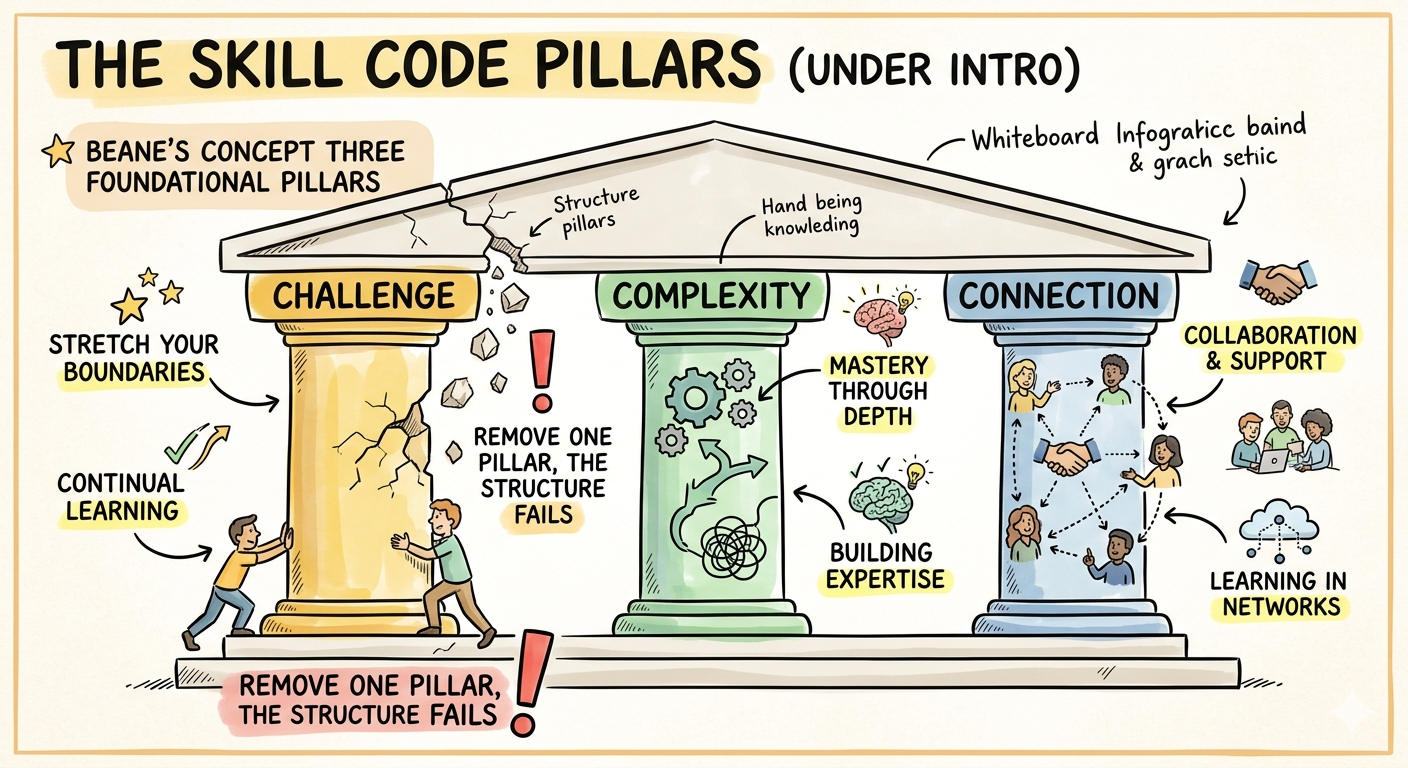
The three pillars: Challenge, Complexity, and Connection.
Beane breaks this down into the Skill Code: Challenge, Complexity, and Connection. Drop even one of these, and the learning stack crashes. Drop all three—which is exactly what we’re doing by blindly throwing LLMs at everything—and you get a generation of prompt-kiddies with credentials but zero capability.
Nuking the Tutorial Level
The core bug in the modern workplace is simple: AI is eating the “near zone.”
You don’t level up by doing tutorial-level garbage, and you don’t level up by trying to write a custom kernel from scratch on day one. You level up in the near zone—that sweet spot where the problem is just hard enough to make you sweat, but not so hard that you wipe the production database. For a junior dev, that’s writing unit tests or debugging legacy spaghetti code. For a junior surgeon, it’s closing incisions.
That only works if the person actually wants to learn, which is why Learning starts with desire lands on the same core principle from a different angle.
That’s exactly the grunt work AI automates first.
Beane looked at hospitals using surgical robots. The attending surgeon gets faster. The machine does the heavy lifting. The resident? Their active learning time plummeted from four hours down to fifteen minutes. They’re just standing there watching. The entry-level grind—the exact friction required to train the neural net inside your own skull—is gone. We are literally deleting the tutorial level of real life. Entry-level jobs are getting nuked because suits think an LLM replaces the need to train juniors.
The Abstraction Trap
AI hides the mess. It outputs clean, perfectly formatted data and hides the chaotic, multi-threaded reality of how it got there. If you never see the mess, you never understand the system.
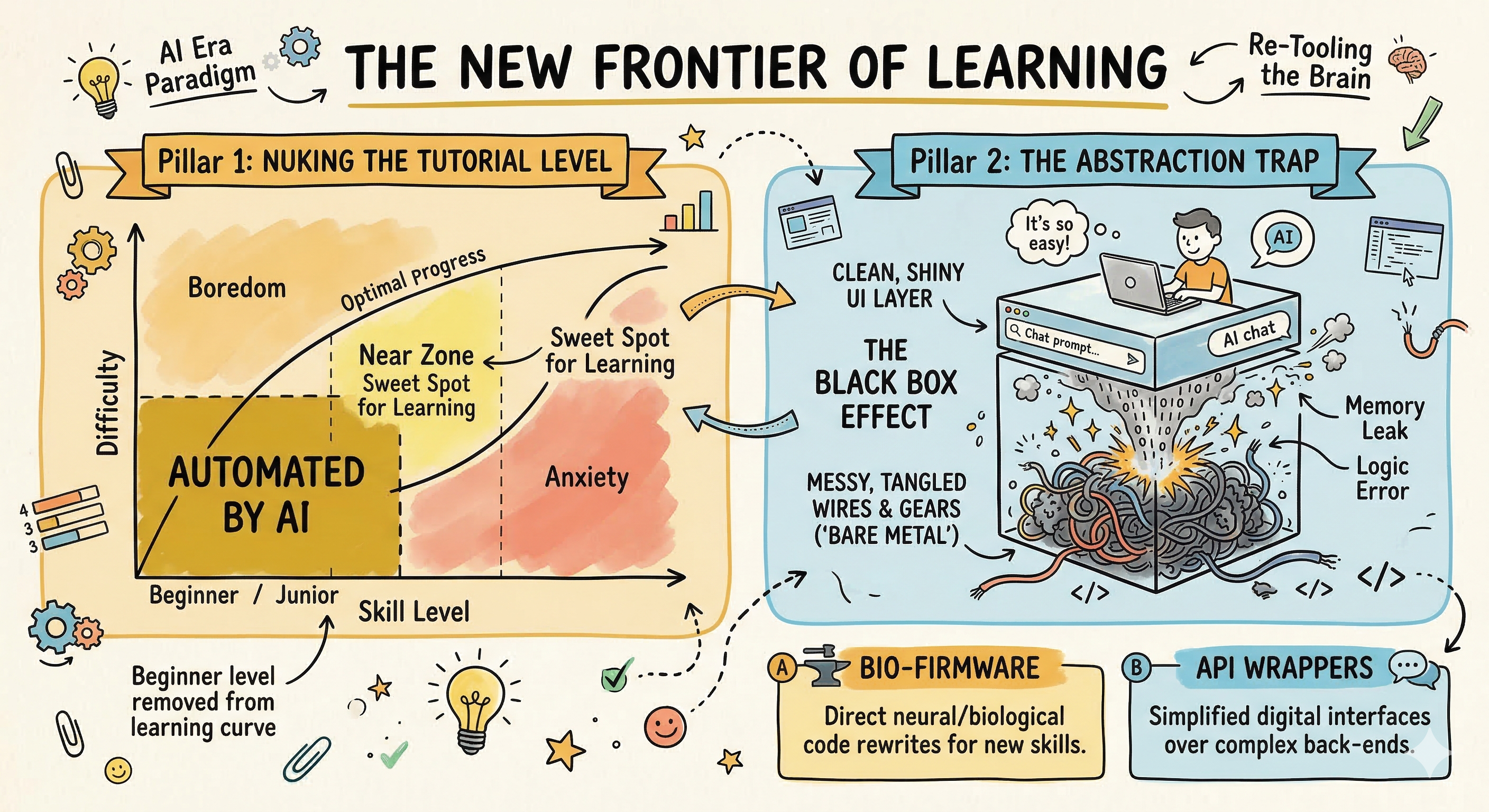
AI outputs clean data but hides the chaotic reality.
A great hacker knows how to pivot when the abstraction leaks—and it always leaks. You learn this contextual brilliance by being immersed in the mess, not by watching a clean UI. Modern workflows bury the complexity under layers of algorithmic abstraction. You feed a prompt into a black box, and you accept the output. When the machine inevitably breaks, you have zero context to fix it because you never actually touched the bare metal.
Why Mentors Don’t Scale (And Why That Matters)
Connection. The corporate world hates it because it doesn’t scale. You need a mentor. Not an AI tutor. Not a Coursera certificate. A real, high-level operator who actually gives a damn if you succeed.
An AI can give you adaptive difficulty. It can simulate a sandbox. But an AI doesn’t care about you. A real mentor calibrates the pressure. They let you fail just enough to learn the lesson, but step in before you blow up the servers. When the senior dev is just managing AI outputs instead of reviewing your pull requests, that feedback loop is dead. The expert is still in the room, but their bandwidth is entirely hijacked.
Stop Optimizing Away the Friction
People argue that AI makes training faster. Sure, it makes you fast at using the tool. It doesn’t make you a master of the craft.
We are systematically gutting human capability in the name of pure efficiency. The fix: don’t let the machine steal your reps. Stop optimizing away the hard parts. Dig into the complexity. Read the source code. Find a greybeard who actually knows how the bare metal works and learn everything they know.
Rely on the machine to do the thinking, and you aren’t a builder anymore. You’re just an API wrapper.